|
|
 |
 | Medical News Releases > Faculty Experts at Washington University in St. Louis >

Professor of Polymer and Organic Chemistry in Arts & Sciences
Expertise: nucleophilic attack, graft copolymer micellar structures, liquid crystalline sub-units, Dendrimeric cylinders, Shell-crosslinked Knedels, amphiphilic nanometer-sized spheres, hyperbranched polycarbonates, synthesis of perflouorinated hyperbranched materials, degradable polymers, macromolecular architectures, unique polymeric materials, material science, atomic force microscopy, nanotechnology, bioorganic chemistry, polymers, nanoparticles
Bio:
Karen L. Wooley, Ph.D, professor of chemistry, has done important research in polymers and nanoparticles. Her interests include bioorganic chemistry; nanotechnology; material science; and atomic force microscopy. These interests are broadly focused upon the design, synthesis and characterization of unique polymeric materials. Her group is developing creative methods for the construction of new types of materials, and accurate placement of functionalities within such macromolecular systems.
WUSTL Contact Information:
| Work: | (314) 935-7136 |
| Fax: | (314) 935--9844 |
|
|
Education:
-
Ph.D. in Polymer and Organic Chemistry at Cornel University

| News Stories & Tip Sheets: |
Showing Stories 1 through 5 of 9.
- Show More |
 |
An alternative to chemotherapy
 Nanoparticles tackle pediatric brain tumors

July 14,
2008 --
An interdisciplinary team of researchers at Washington University in St. Louis, led by Karen L. Wooley, Ph.D., James S. McDonnell Distinguished University Professor in Arts & Sciences, is a step closer to delivering cancer-killing drugs to pediatric brain tumors, similar to the tumor that Senator Ted Kennedy is suffering from. Such tumors are often difficult to completely remove surgically; frequently, cancerous cells remain following surgery and the tumor returns. Chemotherapy, while effective at treating tumors, often harms healthy cells as well, leading to severe side effects especially in young children that are still developing their brain functions. In an effort to solve this problem, the Wooley lab has developed polymeric nanoparticles that can entrap doxorubicin, a drug commonly used in chemotherapy, and slowly release the drug over an extended time period.

|
Whitesides ponders the origin of life
 Harvard professor George Whitesides ponders new ideas in chemistry and the origin of life

Jan. 24,
2008 -- Innovative researcher George Whitesides will speak on revolutionary ideas in chemistry that may lead to a new understanding of the origin of life for the Ferguson Science Lecture at 11 a.m. on Wed., Feb. 6 in Graham Chapel as part of the Assembly Series.

|
Tiny helpers
 Nanostructures show potential to aid in the diagnosis and treatment of pediatric brain cancer

April 9,
2007 --
 |
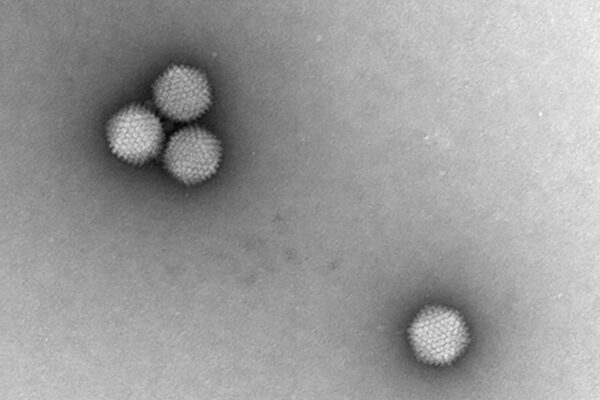
| The magnified nanoparticles shown here are actually about 1,000 times smaller than the width of a human hair. |
Chemistry meets biology in this innovative research program. Using synthetic particles invisible to the naked eye, researchers hope to better diagnose and treat childhood brain cancer, the third most common cancer of children. The particles are called nanostructures or nanoparticles because they are measured in nanometers, an almost unimaginably small unit, a billion times shorter than a yardstick.

|
Like a sponge
 Triple threat polymer captures and releases

June 8,
2006 --
 |
| David Kilper/WUSTL Photo |
| Karen L. Wooley and lab members examine polymer samples. |
Download
|
A chemist at Washington University in St. Louis has developed a remarkable nanostructured material that can repel pests, sweeten the air, and some day might even be used as a timed drug delivery system — as a nasal spray, for instance. Karen L. Wooley, Ph.D., Washington University James S. McDonnell Distinguished University Professor in Arts & Sciences, has taken the same materials that she developed more than four years ago as marine "antifouling" coatings that inhibit marine organisms such as barnacles from attaching to the hull of ships to now capture fragrance molecules and release them at room temperature. More...

|
The road not taken
 Electrons choose another path in photosynthesis protein

May 4,
2006 --
 |
| David Kilper/WUSTL Photo |
| Christine Kirmaier (left) and Dewey Holten making adjustments in their sophisticated laser laboratory. Their findings advance the understanding of photosynthesis. |
Download
|
In the famous Robert Frost poem, "The Road Not Taken," the persona, forced to travel one of two roads, takes the one less traveled by, and "that has made all the difference." Chemists at Washington University in St. Louis and Stanford University, in kinship with Frost, have modified a key protein in a bacterium to move electrons along a pathway not normally traveled by. They got this to happen 70 percent of the time. That yield "makes all the difference." More...

|
Showing Stories 1 through 5 of 9.
- Show More |
 |
| Clips: |
Showing 2 Clips.
|
 |
Finding Industry Funding
Science Magazine

March 14,
2008 -- WUSTL's Karen Wooley, professor of chemistry, comments on the difficulties and approaches academic researchers use to garner industry funding.

|
Universities selected for nanotech research
San Francisco Chronicle, St. Louis Post-Dispatch
and 10 others

Oct. 4,
2005 -- WUSTL is one of seven university consortia selected by the National Cancer Institute to spearhead research hubs called Centers of Cancer Nanotechnology Excellence, which will bring together academic laboratories and private firms to develop anti-cancer products.
The research involves the use of molecular-scale nanotechnology devices to detect and destroy tumor cells.
From the Post-Dispatch article -- the WUSTL center will be headed by Samuel Wickline.
In April, WUSTL got another grant, worth $12.5 million, for a separate nanotechnology center headed by chemist Karen Wooley.

|
Additional Background: There are two main areas of research within the Wooley group: investigation of new types of macromolecular architectures and preparation of degradable polymers possessing controllable rates of cleavage.
Macromolecular Architectures
In the area of macromolecular architectures, highly branched polymers have shown unusual physical properties in comparison to traditional linear polymer chains. The group studies the synthesis of perfluorinated hyperbranched materials, and their ability to serve as minimally-adhesive and chemically-resistant materials. Hyperbranched polycarbonates are being studied as soluble and reactive analogs to the polycarbonates that are typically used as excellent engineering materials. Micromechanical properties of these materials are investigated with atomic force microscopy.
Nanoscale
Shell-crosslinked Knedels, amphiphilic nanometer-sized spheres, assembled through micellar-organization followed by linking together of the peripheral shell, contain a mobile hydrophobic core surrounded by a water-soluble layer. Such structures are being targeted for applications as broad as drug delivery, encapsulation technologies, coatings, pollutant removal systems, catalysis, composites, among others. Hollowing of the nanoparticles, via excavation of the hydrophobic core material, produces nanoscale cage-like structures, which are being developed for performance as mimics of viral capsids. Dendrimeric cylinders, liquid crystalline sub-units and graft copolymer micellar structures also are being developed for the construction of the desired architectures; and, degradable polymers. Poly(silyl ester)s, containing labile silyl ester bonds along the backbone of the polymer, are studied as a new family of degradable polymers in which stability toward nucleophilic attack is dependent upon the substituents attached to the silicon atoms.
Affiliated with Barnes-Jewish Hospital and St. Louis Children's Hospital, members of BJC HealthCare.
Please contact us and let us know how we can assist you.
Technical problems with this Web site? Email questions or comments.
Please review the WUSTL News & Information copyright/privacy policy.
|  |
|
|  |  |
|